



There are more than 1.1 billion smart meters installed worldwide today. By 2030, analysts expect that number to exceed 2 billion. They sit quietly on the side of homes, apartment blocks, commercial buildings, and factories - measuring energy consumption, relaying data in real time, and responding to commands from utilities hundreds of miles away.
Most people never think about them. That invisibility is precisely what makes them dangerous.
Smart meters are no longer just metering devices. They are software-defined, network-connected endpoints embedded directly into the power grid. They speak to utility back-ends, feed data into demand-response programs, receive remote firmware updates, and in many deployments, can interrupt or restore electricity supply at the flip of a digital command. In short, they are operational technology (OT) assets with IT-level connectivity - and they are being secured, in most cases, as if they were neither.
This blog explores the attack vectors unique to smart meter infrastructure, the consequences of successful attacks, and the energy-contextual cybersecurity safeguards that utilities and grid operators must implement today. We also explain why SaiFlow's approach - purpose-built for the physics and protocols of energy infrastructure - is uniquely positioned to help.
"A compromised smart meter is not a stolen password. It is an unauthorized command with a direct line to your grid."
What Makes Smart Meters Different - and More Dangerous
To understand the threat, it helps to understand how far smart meters have evolved from their analogue predecessors.
Traditional electromechanical meters were passive, read-only devices. A utility worker came by once a month, wrote down a number, and left. The attack surface was approximately zero.
Advanced Metering Infrastructure (AMI) - the technical term for smart meter systems - introduces a fundamentally different architecture. A modern smart meter is a networked embedded computer that:
- Communicates bidirectionally with a utility's head-end system (HES) over RF mesh, cellular, or PLC networks.
- Accepts remote commands: disconnect/reconnect, firmware updates, tariff changes, demand-response signals.
- Stores and transmits granular consumption data at 15-minute or even per-minute intervals.
- May connect to in-home devices, EV chargers, solar inverters, and home energy management systems through a Home Area Network (HAN).
- Is physically accessible - installed on the exterior of buildings.
The result is a system that combines the scale of consumer IoT, the connectivity of enterprise IT, and the physical consequences of industrial OT. No other asset class in the energy sector is simultaneously so numerous, so connected, and so under-secured.
Mapping the Attack Surface: Where Smart Meters Are Vulnerable
The AMI ecosystem has a wide and layered attack surface. The threat is not a single vulnerability but a matrix of entry points spanning communication protocols, firmware, physical hardware, and back-end systems.
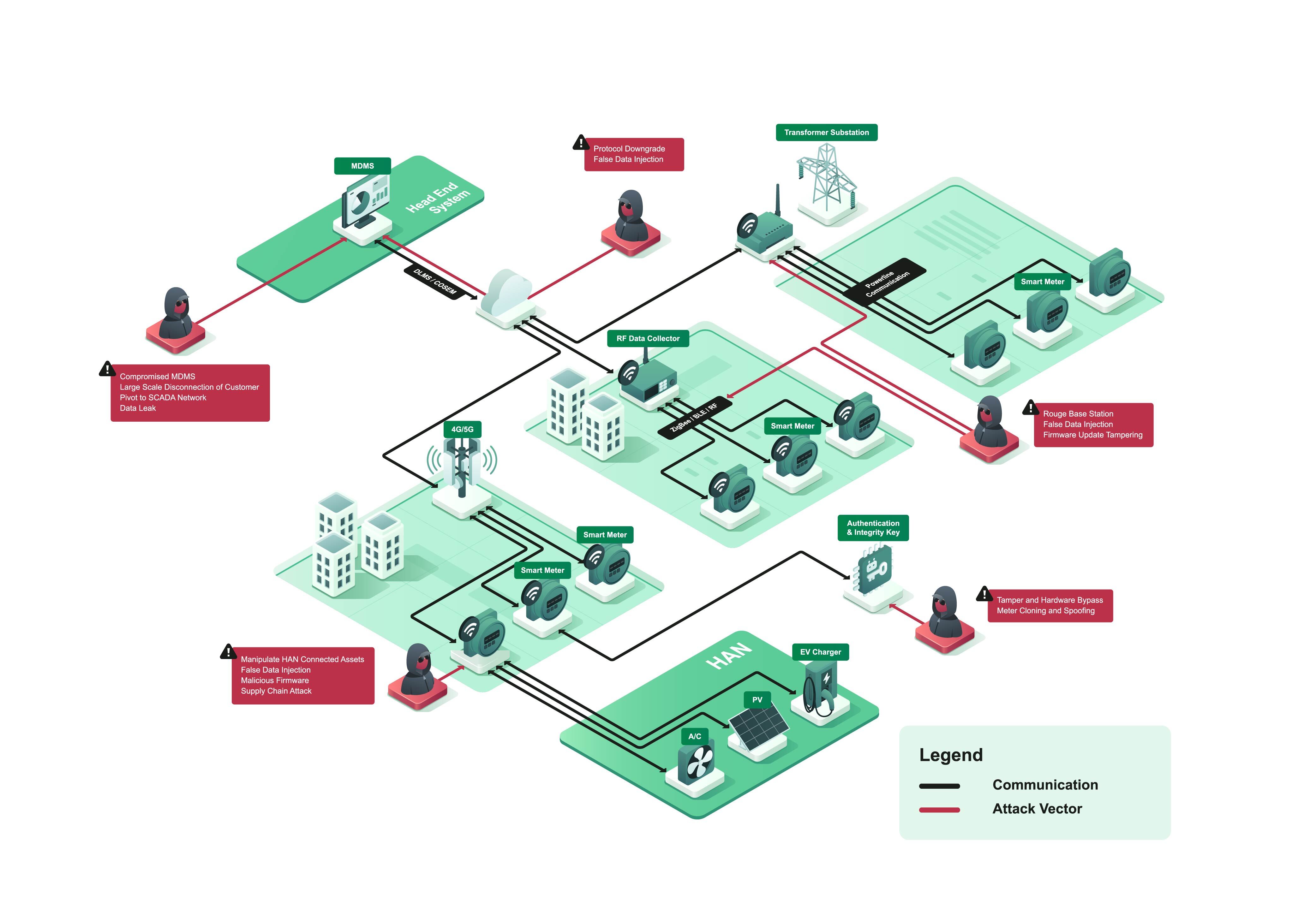
We organize these into four primary attack vector categories:
1. Wireless Communication Layer Attacks
AMI networks rely on RF mesh, cellular (2G/4G/5G), and powerline communication (PLC) to connect millions of meters to data concentrators and back-end systems. These wireless channels are inherently broadcast - anyone within range can observe them, and in many deployments, they remain weakly authenticated or unencrypted.
- Rogue Base Station / Man-in-the-Middle: An attacker spoofing a data concentrator can intercept and modify meter readings, inject false demand-response signals, or replay commands - including disconnect orders.
- RF Jamming: Deliberately saturating the communication frequency prevents meters from transmitting, creating artificial data gaps that can be exploited for billing fraud or to mask other attacks.
- Protocol Downgrade: Many AMI networks support legacy protocol fallback. Forcing a meter to negotiate a weaker protocol version can strip away encryption and authentication protections entirely.
2. Firmware and Supply Chain Compromise
Smart meters receive firmware updates over the air (FOTA) - a necessary operational feature that becomes a critical attack vector when not properly secured.
- Malicious Firmware Injection: If the firmware update channel lacks strong code-signing verification, an attacker can push modified firmware that alters metering logic, opens a persistent backdoor, or disables safety controls. A compromised meter remains compromised through every subsequent legitimate update.
- Supply Chain Implants: Hardware or firmware trojans embedded during manufacturing bypass network-layer defenses entirely. These implants may lie dormant for months or years before activation - and may never be detected by conventional security tooling.
- Bootloader Vulnerabilities: Weak or unprotected bootloaders allow an attacker with physical access to completely replace meter firmware, even if FOTA updates are otherwise secured.
3. Head-End-System (HES) and Back-End Compromise
The utility's head-end system - which manages communications with potentially millions of meters - is a high-value target. Compromising the HES provides an adversary with command authority over the entire AMI fleet.
- Mass Disconnect Attack: A threat actor who gains unauthorized access to HES can issue simultaneous disconnect commands to large populations of meters. Unlike a physical grid failure, this attack is near-instantaneous and geographically precise - targeting a neighborhood, a city, or critical facilities.
- Data Manipulation at Scale: Falsifying consumption data fed into the MDMS (Meter Data Management System) corrupts billing, settlement, and grid planning. At scale, this can distort wholesale energy markets.
- Lateral Movement into Grid OT: AMI back-end systems frequently share network segments with SCADA and distribution management systems. A compromised HES can serve as a beachhead for deeper incursion into grid operational infrastructure.
4. Physical and In-Home Network Attacks
Smart meters are physically exposed on building exteriors - a stark contrast to the hardened facilities that house grid substations and control centers.
- Tamper and Hardware Bypass: Physical access allows attackers to probe debug ports (JTAG/UART), extract cryptographic keys, clone meter identities, or install hardware implants that enable persistent remote access.
- Meter Cloning and Energy Theft: Physical access to a meter's hardware can expose its cryptographic keys through debug port probing (JTAG/UART) - a well-documented vulnerability in embedded devices. In legacy AMI deployments, where symmetric keys are hardcoded into device firmware at the factory and shared across meters of the same model, a single extraction can unlock impersonation of many devices across the same fleet. Even in isolation, a cloned identity allows an attacker to falsify consumption of readings and evade billing detection entirely.
- Home Area Network (HAN) Exploitation: Smart meters often act as ZigBee or Wi-Fi gateways to in-home devices. A compromised meter can be used as a pivot point to attack EV chargers, solar inverters, HVAC systems, and other connected assets inside the premises - or conversely, a compromised HAN device can attack the meter.
Beyond Billing Fraud: The Real Consequences of Smart Meter Attacks
Cybersecurity conversations about smart meters often fixate on the most visible risk - energy theft and billing fraud. These are real and significant - a World Bank estimate puts energy theft losses at approximately $96 billion annually worldwide, a figure that more recent analysis suggests may now exceed $100 billion. But they represent only the surface of what is actually at stake.
Grid Stability Threats
Demand response programs rely on smart meters to shed load during grid stress events. An adversary who compromises these signals - either preventing response or artificially inducing load shedding at the wrong moment - can contribute to frequency instability or cascading failures. A coordinated attack on metering infrastructure in a high-density urban area could rival the impact of a conventional physical attack on a transmission substation.
Mass Service Disruption
Unlike most IT infrastructure, smart meters control physical switches with real-world consequences. Remote disconnect functionality - designed to streamline customer service operations - becomes a weapon in the wrong hands. A motivated adversary could cut power to hospitals, water treatment facilities, or entire residential districts within minutes, using nothing more than compromised HES credentials.
Data and Privacy Violations
Granular consumption data reveals occupancy patterns, appliance usage, and behavioral routines with surprising precision. Leaked AMI data has been shown to expose whether a home is occupied, identify specific appliances in use, and even infer sensitive personal information. At scale, this data is extraordinarily valuable to criminal actors - and to nation-state intelligence operations.
Market Integrity and Financial Impact
Manipulated meter data corrupts the inputs to real-time energy markets, settlement systems, and grid planning tools. At sufficient scale, falsified consumption data can move wholesale prices, create artificial demand signals, and enable sophisticated financial fraud in electricity markets - with consequences that ripple far beyond the utility sector.
The Cascading Infrastructure Risk
Perhaps the most underappreciated consequence is not what attackers do to meters directly, but what they do with them. A fleet of compromised meters can serve as a botnet - launching coordinated denial-of-service attacks, participating in grid-destabilizing load manipulation, or acting as persistent footholds for attacks on deeper grid infrastructure. The meter is not the target. It is the weapon.
"The meter is not the target. It is the weapon. A compromised AMI fleet gives an adversary command authority over millions of physical switches simultaneously embedded in the grid."
Implementing Energy-Contextual Cybersecurity for Smart Meters
Defending smart meter infrastructure requires a fundamentally different approach than conventional IT security. The protocols are different. The physics matter. The scale is enormous. And the operational constraints - 24/7 availability, legacy hardware, diverse vendor ecosystems - mean that traditional enterprise security tools will fail when applied without adaptation.
Below are the core safeguards that utilities and grid operators must implement - organized around the principle of energy-contextual security:
1. AMI-Native Asset Visibility and Inventory
You cannot protect what you cannot see. Many utilities operate AMI networks with incomplete inventories of meter firmware versions, communication module types, and cryptographic capabilities. The foundation of any security program is continuous, automated asset discovery across the entire AMI fleet - tracking hardware versions, firmware baselines, communication parameters, and behavioral profiles for every endpoint.
Energy-contextual asset visibility goes further: it correlates device identity with physical location, grid topology, and operational role - enabling risk prioritization that accounts for the physical consequences of compromise, not just device count.
2. Protocol-Aware Anomaly Detection
AMI networks use a mixture of proprietary and standard-based protocols (such as DLMS/COSEM). Generic network monitoring tools cannot interpret these protocols, let alone detect semantic anomalies within them - malformed commands, unauthorized function codes, or out-of-range register values that indicate manipulation.
Effective detection requires deep packet inspection of AMI-specific protocols, combined with physics-based reasoning. A consumption reading of zero across thousands of meters at peak demand is not a network anomaly - it is a physical impossibility that almost certainly indicates data manipulation. Security systems that understand energy physics will catch this in real time. Systems that do not, will not.
3. Behavioral Baselines at Fleet Scale
At AMI scale - hundreds of thousands to millions of meters - individual device monitoring is impossible. Effective detection requires machine-learning models that establish normal behavioral baselines for meter populations, communication patterns, and HES interactions. Deviations from these baselines - a sudden spike in disconnect commands, anomalous firmware update patterns, unexpected communication flows - are flagged for investigation.
Critically, these baselines must account for legitimate operational diversity: seasonal demand variations, demand-response events, rolling firmware update campaigns, and tariff changes all alter normal behavior. Security systems that lack this operational context generate excessive false positives, leading to the alert fatigue that leaves real threats undetected.
4. Firmware Integrity and Secure Update Pipelines
Every over-the-air firmware update is a potential attack vector. Robust code-signing requirements - with cryptographic verification performed on the meter itself before any firmware is executed - are non-negotiable. Update pipelines must be hardened end-to-end: from the utility's software management system, through the HES, down to the individual meter.
Continuous monitoring of firmware integrity across the fleet - detecting unauthorized modifications, unexpected version rollbacks, or anomalous update sequences - provides early warning of supply chain compromise or FOTA-based attacks before they propagate at scale.
5. Zero Trust for AMI Command and Control
Remote disconnect and other high-consequence commands require a zero-trust approach: authenticate the command source, authorize against role-based policies, validate against operational context (is this a normal time for disconnects? Is this targeting a critical facility?), and log immutably for audit.
A zero-trust model also applies to the HES itself - treating it as a potentially compromised system and verifying command authenticity at the meter, not only at the back-end. This limits the blast radius of a HES compromise to authenticated, policy-permitted actions rather than unconstrained command authority.
6. Incident Response Designed for Physical Consequences
When a smart meter incident occurs, the response playbook cannot mirror an enterprise IT breach response. The questions are different: Which meters are affected? Are any critical facilities at risk of service disruption? Is this isolated or coordinated? What is the safe operational state to restore while investigation proceeds?
Pre-defined playbooks for common AMI attack scenarios - mass disconnect attempts, rogue firmware propagation, HES credential compromise - must be coordinated across cybersecurity, grid operations, and customer service functions. Forensic log preservation, regulatory notification procedures, and safe restoration protocols must all be specified in advance, not improvised under operational pressure.
The Regulatory Landscape: Necessary but Insufficient
Regulatory attention to AMI cybersecurity is growing, but significant gaps persist:
- NERC CIP applies to bulk electric system assets, but smart meters - which operate at the distribution level - fall outside its scope in most jurisdictions. Millions of connected grid endpoints remain unregulated.
- NIST IR 7628 (Guidelines for Smart Grid Cybersecurity) provides a comprehensive framework for AMI security, but compliance is voluntary in most markets.
- The EU's NIS2 Directive and the Network Code on Cybersecurity for Electricity are expanding requirements across European grid operators, but implementation timelines and enforcement remain inconsistent.
- IEC 62056 (DLMS/COSEM) and ANSI C12 security extensions define cryptographic requirements for meter communications, but adoption is uneven across vendor implementations and utility deployments.
The practical implication for utilities and grid operators is that compliance alone is not security. The regulatory floor is well below what the actual threat landscape demands. Organizations that wait for mandates to drive their security posture will find themselves perpetually behind the adversary.
Conclusion: The Meter Is Already Connected. Is Your Security?
Smart meters are the silent infrastructure of the modern grid - present everywhere, noticed by almost no one, and increasingly targeted by adversaries who understand their strategic value. Their proliferation is irreversible. Their connectivity is non-negotiable. What remains to be determined is whether the security posture protecting them will match the scale and sophistication of the threat.
The energy sector has navigated this challenge before - with SCADA systems, with industrial control systems, with BESS infrastructure. In each case, the lesson was the same: generic IT security tools, applied without energy domain expertise, are insufficient. The physics matter. The protocols matter. The operational context matters.
Smart meters demand energy-contextual cybersecurity. The tools exist. The expertise exists. The only variable is whether utilities and grid operators will act before the next attack, or after it.
Energy-Contextual Security for Smart Meters: Where SaiFlow Fits
The challenges outlined in this blog are not theoretical. AMI systems are already being probed, and in some documented cases, compromised - by criminal actors pursuing fraud, researchers exposing vulnerabilities, and nation-state actors establishing persistent access. The question is not whether your smart meter infrastructure will be targeted, but whether you will detect and respond before the consequences become operational.
SaiFlow was built specifically to address the cybersecurity challenges of distributed energy infrastructure - including smart meters and AMI networks. Our platform delivers Energy Runtime Security: a purpose-built approach that combines deep knowledge of energy protocols, grid physics, and operational constraints with real-time detection and response capabilities.
What SaiFlow Brings to AMI Security:
- Energy-Contextual Anomaly Detection - SaiFlow's detection engine understands AMI protocols natively, analyzing command patterns, consumption telemetry, and communication behavior against physics-based baselines. We distinguish legitimate operational events from genuine threats, eliminating the false-positive noise that makes conventional security tools unworkable at AMI scale.
- Asset Visibility Across the AMI Fleet - SaiFlow provides continuous, automated inventory of AMI endpoints: firmware versions, communication parameters, cryptographic capabilities, and behavioral profiles. This visibility extends to the relationship between meters and grid topology - so risk is assessed in operational context, not in isolation.
- Zero Trust Enforcement for High-Consequence Commands - SaiFlow's Zero Trust Enforcement capability applies contextual policy verification to remote disconnect commands, firmware update authorizations, and other high-consequence AMI operations - preventing unauthorized or anomalous command execution even if back-end credentials are compromised.
- Unified Energy Security Across Distributed Resources - Smart meters don't exist in isolation. SaiFlow's platform provides unified visibility and protection across AMI networks, BESS systems, EV charging infrastructure, solar inverters, and other distributed energy resources - detecting cross-asset attack patterns that siloed tools will miss.
SaiFlow is already protecting distributed energy infrastructure for utilities, grid operators, and energy companies globally. Smart meters are the next frontier - and we are ready.
SaiFlow provides energy-contextual cybersecurity purpose-built for distributed energy infrastructure. If your organization operates AMI networks, smart meters, or other grid-connected assets, we would welcome the opportunity to discuss how SaiFlow can protect your infrastructure - and what that protection makes possible.