


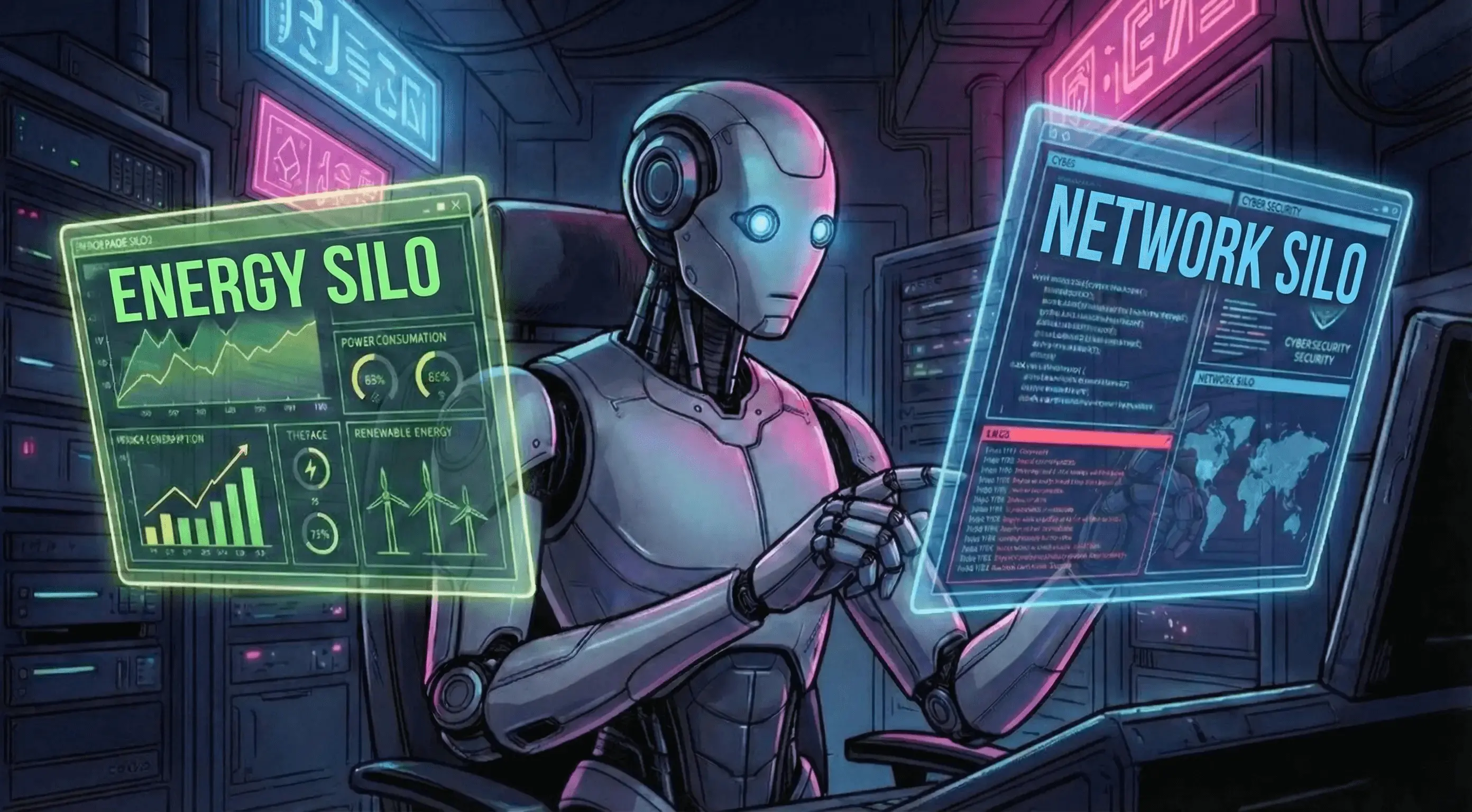
TL;DR SaiFlow's Threat & Incident Assistant for Energy Runtime Security is an AI-powered investigation tool, built into the SaiFlow platform. It helps security teams bridge the gap between what they see (network events, protocol anomalies, authentication logs) and what they're missing (the energy context that explains whether those network events actually matter).
When an alert comes up, security analysts can activate the assistant to correlate security data with energy telemetry, asset inventory, and historical baselines. In under 40 seconds, it delivers a confidence-backed verdict, key evidence, and prioritized response actions. The result: faster investigations, fewer blind spots, increased accuracy, and a shorter window of exposure when threats are real.
This post walks through the problem, how the AI assistant solves it, and a real investigation example.
The Contextual Gap
We recently explored why contextual cybersecurity matters in energy networks: when network activity and energy activity remain siloed, security teams lose visibility into threats that span both domains. The solution is fusing these data streams into a unified view.
But visibility is only half the battle. When a security alert comes up in an energy environment, your SOC sees the event logs: timestamps, protocol anomalies, affected assets. What they don't see is whether the lights just went out.
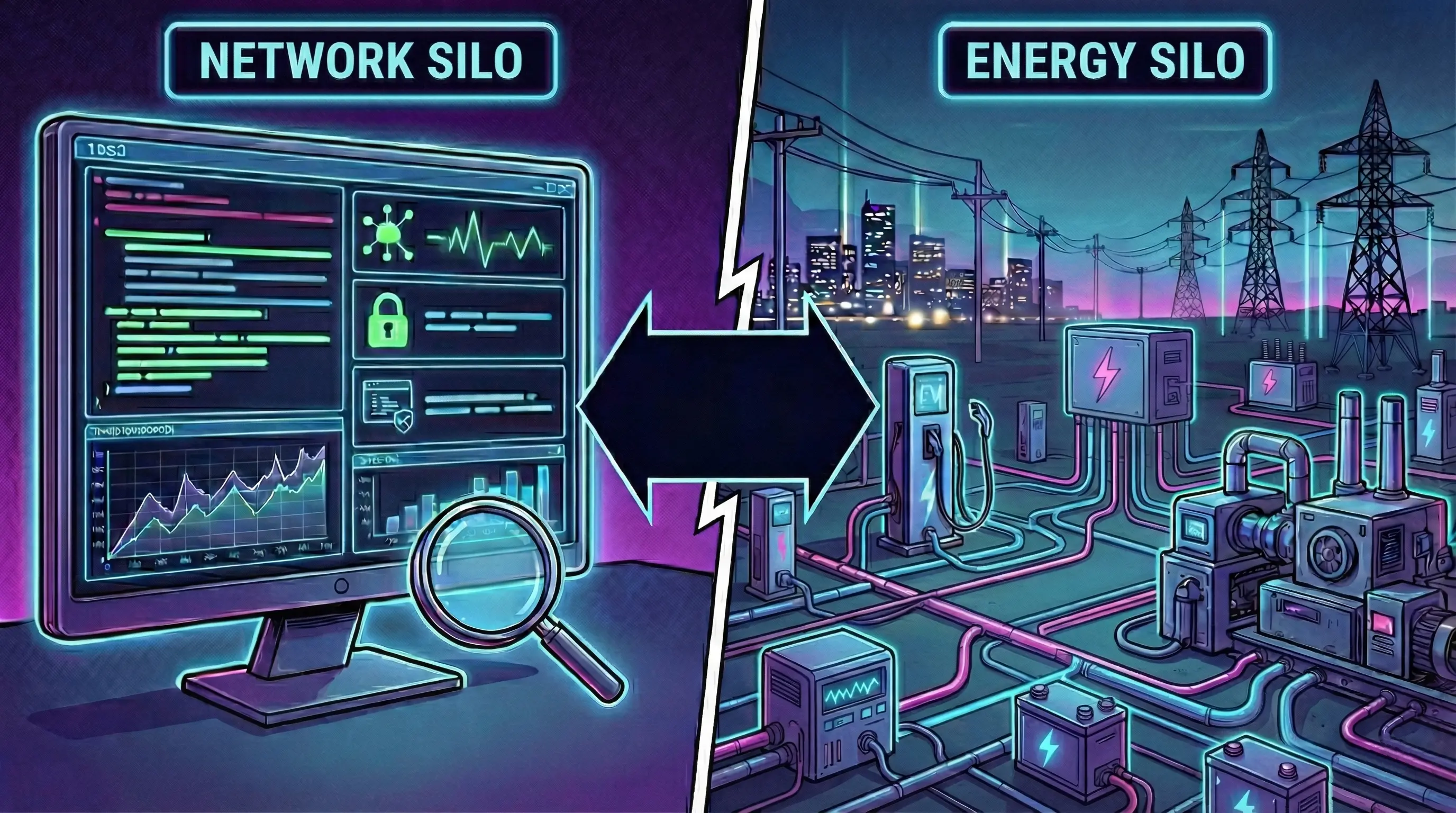
This is the contextual gap that defines energy security investigations. Your security team can identify network anomalies, authentication failures, and protocol violations, but without the energy context, they can't determine what those events actually mean.
A burst of OCPP authorization requests, in an EV charging site, might look like noise. An unusual message pattern might get deprioritized. Even experienced security analysts, trained to spot threats in traditional IT environments, can look directly at an energy-specific attack and not recognize it for what it is. The signals are there; the context to interpret them isn't.
Meanwhile, the cyber exposure window stays open. Every hour spent correlating logs, pulling in OT teams, and manually piecing together the operational picture is an hour the attacker remains inside your environment, moving laterally, escalating access, or preparing for impact. And because the security team can't yet quantify the operational risk, they can't prioritize the response.
The result: critical incidents get treated like routine alerts, and threats that should trigger immediate action sit in a queue.
The Cost of the Gap
This gap has a direct cost: time. Mean-Time-to-Resolve (MTTR) in energy security isn't just an operational metric; it's the duration of your critical infrastructure’s exposure. Every minute spent manually correlating logs, waiting on cross-team input, or second-guessing whether an alert is a real threat is a minute the attacker remains inside your operational environment.
For energy infrastructure, where operational disruption can cascade into safety risk and service outages, that window matters more than in traditional IT. Reducing MTTR isn't about efficiency. It's about shrinking the opportunity an adversary has to inflict substantial damage.
And that window is getting harder to defend. Attackers are increasingly leveraging AI to automate reconnaissance, accelerate exploitation, and probe for weaknesses at machine speed. An enumeration attack that once required manual effort now runs in seconds. A vulnerability scan that took hours now completes before your team finishes triaging the first alert.
When the offense operates at AI speed, defenders relying on manual investigation and cross-team coordination are playing a losing game. The response has to match the tempo of the threat.
Introducing the Threat & Incident Assistant
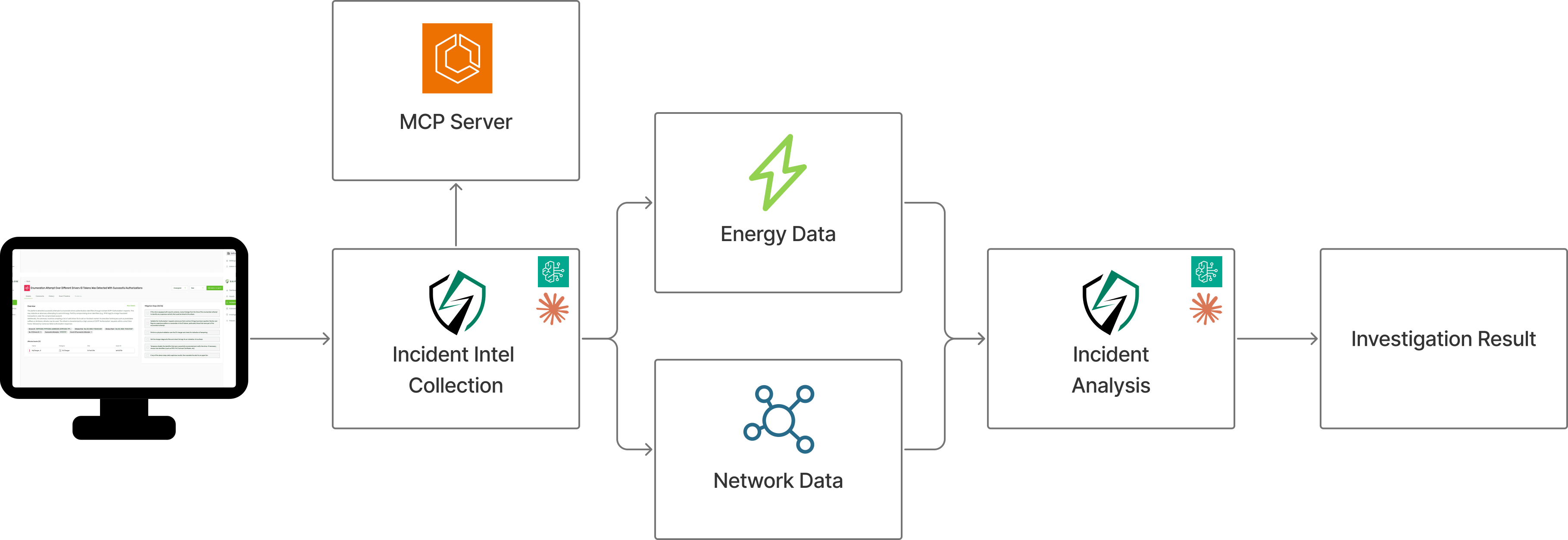
SaiFlow's Threat & Incident Assistant for Energy Runtime Security is built to close this gap at the speed the threat landscape now demands.
When your security analyst needs to investigate an alert, they can trigger the AI assistant to pull together what the security team sees with what they're missing: energy IoT asset inventory, related network events, energy time-series data, correlated alerts, and historical baselines. It doesn't just surface raw data. It synthesizes the security event with the energy context and delivers a conclusive verdict (was this an actual cyber incident or an operational anomaly?) along with the evidence trail that supports its conclusion.
The result is an investigation that used to require hours of cross-team coordination, log correlation, and manual analysis, completed in seconds. Your security analysts get actionable findings, prioritized response recommendations, and the confidence to act without waiting on context from teams operating on different timelines.
This isn't about replacing your security team. It's about giving them instant fluency in the energy domain so they can make faster, better-informed decisions. The expertise still drives the response; the AI assistant just removes the bottleneck that slows it down.
Investigation in Action
Here's what this actually looks like in practice, for an EV charging network.
An alert comes up: "Enumeration Attempt Over Different Drivers ID Tokens Was Detected With Successful Authorizations." The security team sees a spike in OCPP authorization requests and a handful of successful authentications. Is this a misconfigured system? A driver having trouble with their credentials? Or something worse?
Without energy telemetry and energy protocol context, answering that question means digging through logs, correlating timestamps, pulling in the operations team, and hoping someone recognizes the pattern. With the Threat & Incident Assistant, the analyst triggers an investigation and gets a verdict in under 40 seconds.
The AI assistant returns a clear conclusion: 95% confidence that this is a cyber incident, not an operational issue. It surfaces the key evidence, explains why the pattern indicates an automated attack rather than normal behavior, and delivers prioritized response actions so the security analyst knows exactly what to do next.
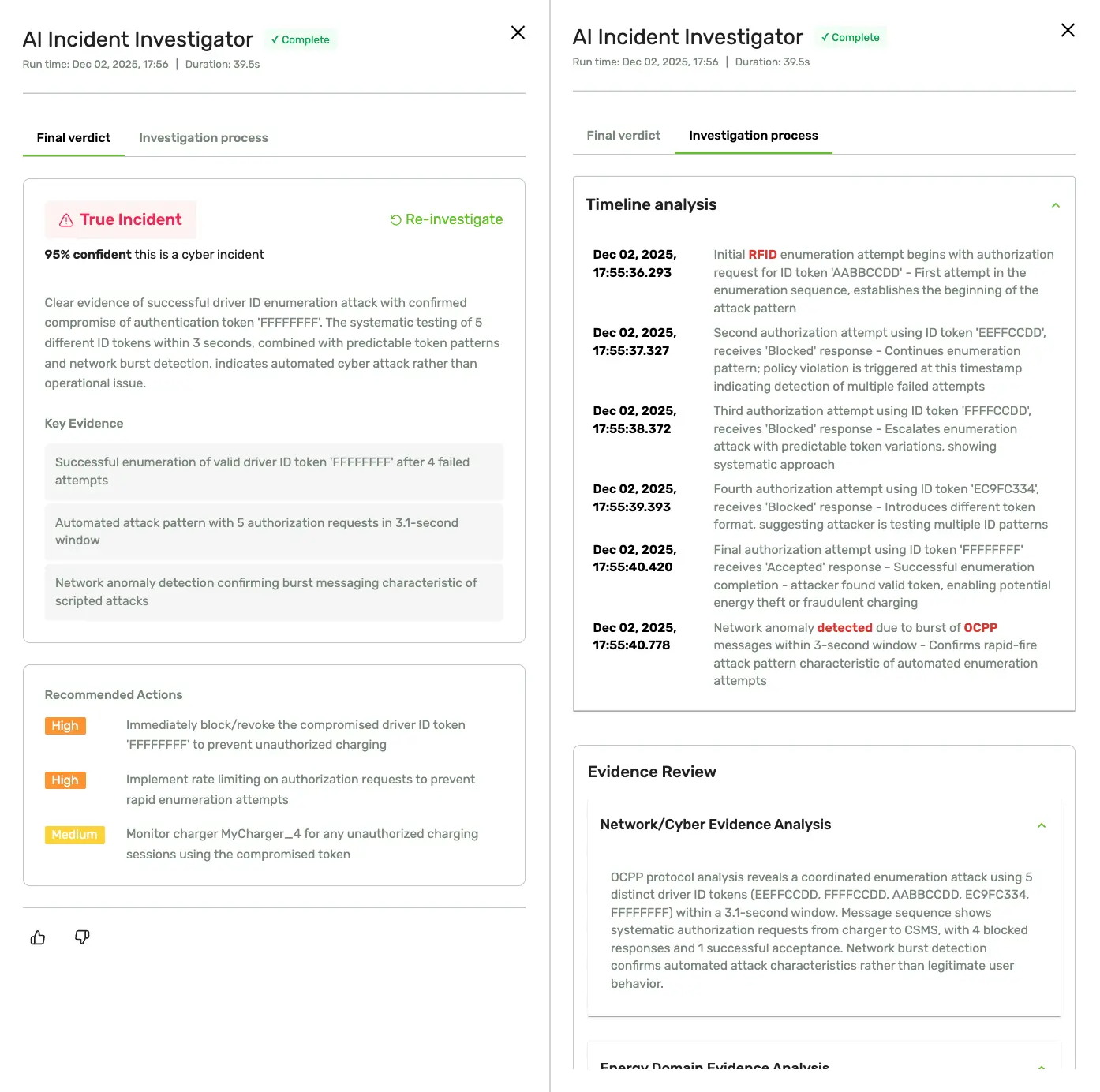
What would have taken hours of investigation and cross-team coordination is now a 40-second path from alert to action.
From Investigation to Response
The assistant's value doesn't end with the investigation. By providing a confidence-backed verdict and prioritized actions, it removes the hesitation that typically follows alert triage. Your security analyst isn't left wondering whether to escalate or wait for more information. They have what they need to act.
High-priority actions get immediate attention. Lower-priority mitigations queue appropriately. And because the assistant documents its evidence trail, the response is defensible and auditable. When leadership asks "why did we take this action?", the answer is already there.
This is how MTTR actually shrinks: not just faster analysis, but faster decisions that flow directly into response.
The Bigger Picture
As energy infrastructure becomes more connected and more targeted, the disconnect between security operations and energy operations becomes a liability you can't afford. Attackers are moving faster, leveraging automation and AI to probe for weaknesses at scale. Defenders need tools that understand both domains and can bridge them in real time.
SaiFlow's Threat & Incident Assistant for Energy Runtime Security is that bridge. It gives your security team the energy context they need, when they need it, without waiting on manual processes or cross-team handoffs.
If you want to turn faster investigations into faster action, book a demo to see it in action.